
















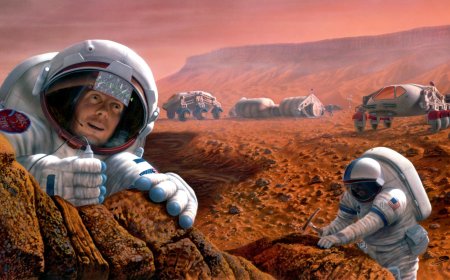



Will Humans Really Live on Mars? Scientists Explore When the Red Planet Could Become Humanity’s Next Home
For decades, the idea of humans living on Mars sounded like something from science fiction. Yet in recent years, scientists and private space companies have increasingly turned this dream into a serious scientific goal. Engineers are building powerful rockets, researchers are studying how humans could survive in extreme environments, and governments are investing billions of dollars in space exploration. But the question remains: will humans truly settle on Mars, and if so, how long might it take before the Red Planet becomes humanity’s second home?


Mars has long fascinated astronomers because it is the planet in our solar system that most closely resembles Earth in several ways. It has seasons, polar ice caps, and evidence that water once flowed on its surface billions of years ago. These characteristics make scientists believe that Mars might be one of the most realistic places for humans to explore and possibly inhabit beyond Earth.
In recent years, space agencies such as NASA and European Space Agency have launched multiple robotic missions to study the planet. One of the most advanced missions is the rover Mars 2020 Perseverance, which landed on Mars in 2021 to collect samples and search for signs of ancient microbial life. The rover is also testing technologies that could help future astronauts survive there.
At the same time, private companies are pushing the boundaries of space travel. Elon Musk, through his company SpaceX, has repeatedly stated that he hopes humans could land on Mars within the next couple of decades. SpaceX is developing a massive spacecraft called Starship, designed specifically to carry large numbers of people and cargo to the Red Planet.
Despite these ambitious plans, scientists say living on Mars will not be easy. The planet has an extremely thin atmosphere, temperatures that can drop far below freezing, and intense radiation because it lacks a strong magnetic field like Earth’s. Any human settlement would require advanced technology to provide oxygen, food production systems, and protection from radiation.
Researchers are already experimenting with how humans might survive there. Some scientists are studying ways to grow plants in Martian-like soil, while others are designing habitats that could be built using materials found on the planet itself. There are also proposals to produce water and fuel directly from resources on Mars, reducing the need to transport everything from Earth.
Another challenge is the journey itself. Mars is incredibly far away, at its closest, it is about 54 million kilometers from Earth. With current technology, a trip to Mars could take six to nine months. This raises serious concerns about the health of astronauts, including exposure to cosmic radiation and the psychological effects of living in isolation for long periods.
Even with these obstacles, many scientists remain optimistic. Some experts believe that the first humans could step on Mars sometime between the late 2030s and early 2040s if technological progress continues. However, creating a permanent settlement where people live for long periods could take much longer, possibly several decades after the first landing.
Beyond science, the idea of living on Mars also raises philosophical questions about humanity’s future. Some researchers argue that establishing a presence on another planet could help protect humanity from global catastrophes on Earth. Others believe the focus should remain on solving problems such as climate change and inequality on our own planet before attempting to colonize another world.
The dream of humans living on Mars is no longer purely imaginary. Thanks to rapid advancements in space technology and ambitious research programs, the possibility is being seriously explored. Yet while the first human footsteps on Mars may happen within the next few decades, turning the Red Planet into a true human home will likely be one of the greatest challenges humanity has ever attempted. Whether it happens in fifty years or a century from now, the question of life on Mars continues to inspire scientists, and the entire world, to imagine what the future of humanity might look like beyond Earth.